
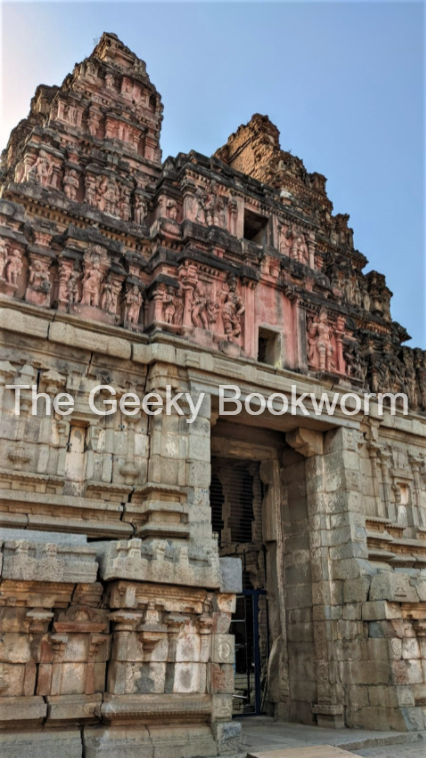
Immersed in rich cultural and historic heritage stands the tall and proud land of Hampi. Surrounded by majestic mountains of granite boulders on one side and the glorious river Tungabhadra on the other, the kingdom which was once the citadel of the vibrant Vijayanagara Dynasty invites history seekers from all over the world.

Although Hampi was always on my bucket list, I never realized its grandeur till I visited it. As soon as one steps into Hampi, the golden era of King Krishna Deva Raya comes alive. Apart from this, one may be surprised to see the historical evidence of the Ramayan in Anegudi(north of Hampi).
Hence, to do complete justice to Hampi, I will be making 3 different posts highlighting the Sacred enclosure, the Royal enclosure and the Ramayan Trail.
Before I get started with the Sacred enclosure, it is important to note that Hampi was once a walled fortress made up of 8 concentric granite walls. In 1330s when the Kingdom was first established by the Royal family of Anegudi, the city was in constant turmoil with the Bahamani Sultanate of Bijapur. To protect their wealth and thrive, 8 concentric walls were made.

They were very well spaced and the entrance of each wall had a temple and a bazaar. There were 7 such massive temples out of which only 1 is currently functional. All the temples were built using an interlocking system.

The bazaars were so vast and affluent that traders from Persia, China and Magnolia reached Hampi to make their fortune. All over the district, there are around 3000 temples and it takes at least a year to delve into every nook and corner of this place.
Vijaya Vittala Temple and Stone Chariot:
After conquering Orissa, when Krishna Deva Raya returned to his capital, he sanctioned the construction of this temple as the symbol of victory. Hence the name Vijaya Vittala (Victorious Lord Krishna). The temple complex restored by ASI (Archaeological Survey of India) consists of the Kalyana Mandapa, Conference Hall, chanting hall and the main temple. It was based on Vastu Shastra (Traditional Indian system of Architecture).

In the late 16th century, when the kingdom was reduced to shambles by the Sultanate, the Deity of this temple was taken to Pandarpur overnight. Hence the Panduranga Vittala came to being. At present, the temple has no Deity but has a very interesting feature, an underground Pradakshina (Circumambulation).
I had goosebumps while I walked around the sanctum sanctorum with minimal light from the tall ceiling. The style of the stone carvings on the walls is Hoysala, Chozha, Chalukya and Konark architecture. Placed in front of the temple is a stone chariot, inspired by the Konark Stone chariot. A picture of this chariot is also found on all Rs. 50 notes.
Right outside, stretched for about 2km was once the Kudrai (Horse) Bazaar. Although in ruins, one can see mandapas resembling stalls stretched on both sides of a sandy road.
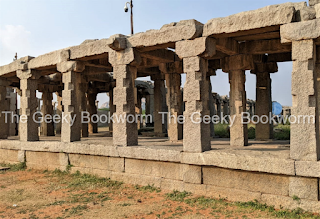 |
| Horse Bazaar |
Now take a moment to close your eyes and transport yourself to the 1500s. Imagine yourself as a member of the royal family, arriving on a steed to attend the cultural program in the evening at the Vittala temple. Visualize the entire temple rejoicing with diyas(earthen lamps) lit all around, the delicious meal being served and ravishing dancers putting up a spectacular show. Yes, the city does come alive!
 |
| Carvings at Hazara Rama Temple |
Hazara Rama Temple:
The Hazara Rama temple situated at the entrance of the Royal enclosure consists of the most delicate carvings. Every wall of this temple carries exquisite carvings of 4 interpretations of the Ramayan, which include Valmiki, Tulsidas, Skanda as well as Jaini Ramayan. These carvings are depicted in horizontal levels.

Virupaksha Temple:
The next temple on this virtual tour is the only ancient functional temple of Hampi, the Virupaksha temple. The only reason why this temple wasn’t looted and destroyed like the rest is that the Deity was adorned only with flowers.
The Shiva Ling here is said to have emerged on its own (Swayambhu). The Gopuram is made from brick and is carved to perfection. The interior pillar carvings were made from black granite of Warangal.

This temple houses a 3 headed Nandi and a pinhole camera which projects the inverted image of the gopuram on the wall in the evening.
One is blown away by the paintings on the ceiling made from organic vegetable colours.
These elaborate paintings depict the story of Lord Shiva and Parvati, the birth of their son Karthikeya and the destruction of Tarakasura.

Right in front of the temple was once a jewellery bazaar. As I stepped into the temple, it was as if I was transported 500 years back to witness the energy and exuberance of the temple complex.
Closing my eyes, I could see the entire temple decorated by beautiful marigold flowers, excited women shopping and the entire area buzzing with trade!

Prasanna Virupaksha Temple:
The most elusive and mystical temple of Hampi is the Prasanna Virupaksha temple. Although it isn’t an active temple, it is indeed extraordinary as it is immersed in water.
The water level increases from 2 to 5 feet as one moves towards the sanctum sanctorum. An engineering marvel, this temple was built in such a way that the excess water from the banana plantation would fill up the temple and make the Lord happy.

Hence the name, Prasanna Virupaksha (Pleased Lord Shiva). At one point, everything became still, the wind stopped blowing and I closed my eyes. It was as if the world stood still and I was doused in a deep meditative state.
According to Robert Sewell, a historian who has led extensive research on the Vijayanagara Dynasty, this kingdom flourished in chaos. Although they were defeated and broken multiple times, they didn’t give up. They rose from the ashes like the Phoenix and became the 2nd richest kingdom in the Medival world, after Beijing.
I highly recommend reading ‘A Forgotten Empire’ by Robert Sewell to learn more about the Vijayanagara Empire.
If Hampi interests you, read about the Royal Enclosure and the remains of the Vanara Kingdom in Kishkindha.





Leave a Reply