
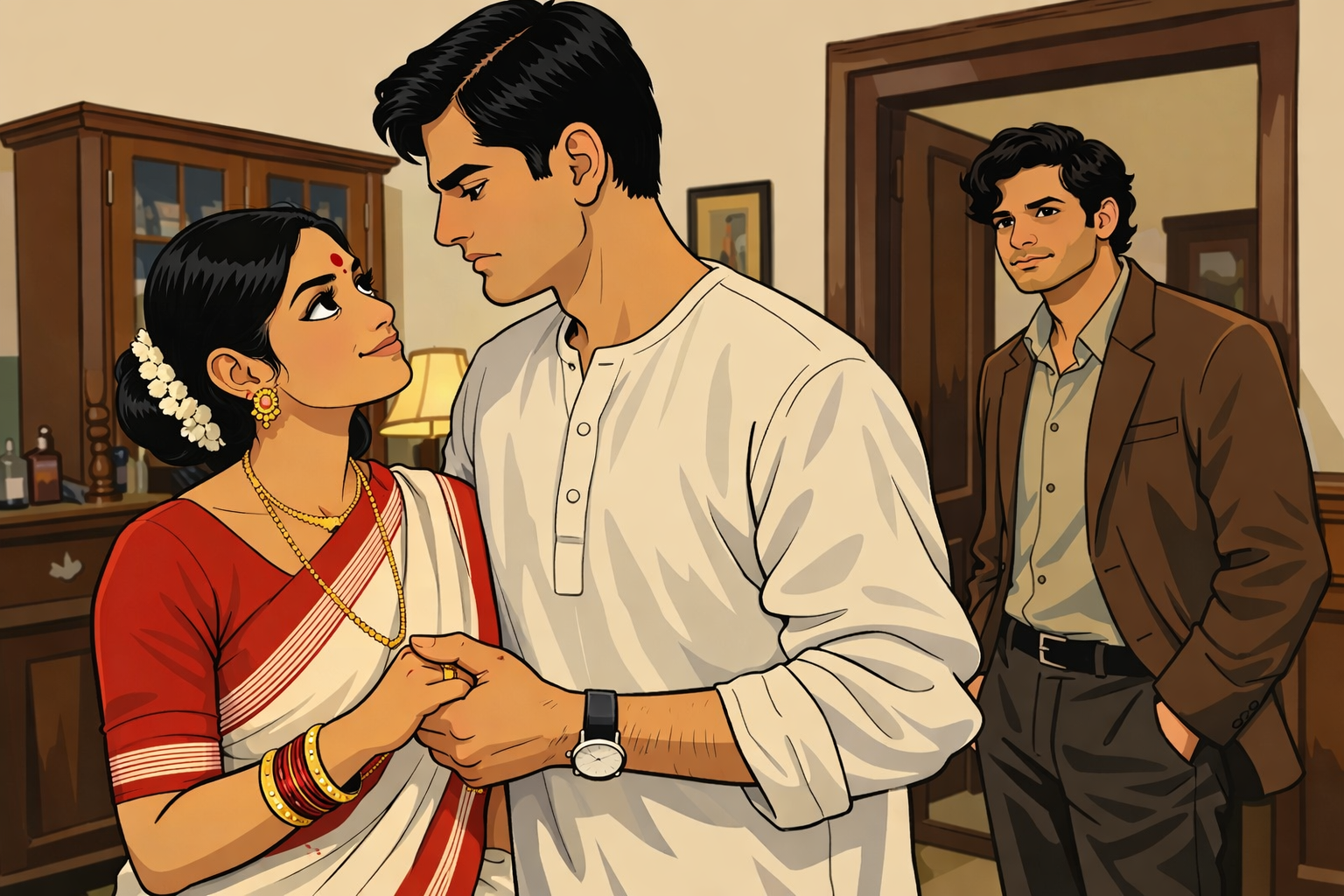
Written by Sarat Chandra Chattopadhyay in 1914, Parineeta might come across as a usual love story to the ignorant eye. But, when you read between the lines, you will realise that Parineeta resists both orthodoxy and loud reformism, offering instead a portrait of female agency rooted in ethical restraint.
An important thing to note is that during that time when the Bengali cultural renaissance was in full swing, Brahmo Samaj started gaining popularity in the higher echelon of the Bengali Society, specifically Calcutta. The elite Tagore family, that is, Debendranath Tagore who split his house into the Hindu house and the Brahmos house, the trickling down of the differences between the two religions through literature, plays and stories; works of this time were documented powerfully. This is the reason why Brahmos makes a strong and liberating appearance in Parineeta.
Sarat Chandra Chattopadhyay:
Sarat Chandra Chattopadhyay is a fantastic literary stalwart who changed the way women were seen in Bengali literature. He wrote from 1907 to 1938 and is known for his works like Devdas, Srikanta, Charitraheen etc. It is very rare to come across a male author who didn’t just write female characters to suit the male gaze but to be characters grounded in reality & comfortable in their skin. After Kalki, I have only seen Sarat Chandra‘s works depicting this!

Title:
Parineeta loosely translates to “espoused”. Throughout this novel, you will see how Lalita’s strong ground in her decision helped her choose her partner against all odds. This doesn’t mean just legal, but also emotional and mental commitment, even before society got to know.
Plot:
The story begins with a poor Gurucharan Babu lamenting at the birth of his fifth daughter to the landlord’s son Shekhar. Apart from this, he is also Lalita’s adoptive father and maternal uncle. Lalita and Shekhar grew up together as very close friends. They had such a close bond that Lalita organises Shekhar’s room while he always provides her with whatever she needs, including money.

The issue starts when Giren Babu enters the picture and Shekhar’s insecurity creeps in. When the talk of Lalita’s marriage appears, Nobin Babu, Shekhar’s father highlights their class difference and demands a hefty dowry, disregarding the already existing compatibility of Shekhar and Lalita. The rest of the novel, follows Lalita and Shekhar’s journey back to each other, her decisiveness and Shekhar’s resolve to get recognition and acceptance.
Themes:
Love as an Ethical Commitment:
When Lalita and Shekhar have an intimate conversation and realise how much they love each other, she immediately accepts the marriage. It was a mental acceptance from Lalita initially and when she sees Shekhar still afraid of societal remarks, she moves away with her family, very briefly. But when she returns and participates in the festivities around Shekhar’s “arranged marriage”, he notices that she adorns the vermillion on her head, accepting him as her soulmate.

It marks mental acceptance of the relationship by Lalita and it pushes Shekhar to stand up for her, against the societal thought and provide her public acknowledgement and acceptance.
Here is where Sarat Chandra masterfully emphasises the resolve of a woman and public structural anchor of a man. In Devdas, the protagonist fails to provide this secure anchor to Paro; who decides to protect her dignity and marry someone else. Shekhar in contrast to Devdas is stable and thoughtful. Love isn’t just a fiery emotion as felt in Devdas but a subtle pillar that exists as an ethical commitment in the eyes of the author.
Class Difference:
Something which is prominent across Sarat Chandra’s works is class difference. Gurucharan Babu is a man drowning in debt and the marginalised society of those times insisted that he pay a sizeable dowry for each of his daughters’ weddings.

This difference is highlighted when talks of Lalita and Shekhar’s wedding comes up but the rich Bhadralok family that Shekhar comes from didn’t want to publicly accept a “lower” class daughter-in-law. The author doesn’t just portray this class difference rather forces you to dwell in this uncomfortable situation and face the emotional conflict, injustice and anger for yourself. This is where this book shines and stays with you.
Rebellion in restraint:
Lalita is a very strong character who in many ways, exhibits her freedom and rebellion, silently but with surety. She doesn’t beg Shekhar to choose her nor does she create a drama and ruckus. But she very decisively and subtly anchors herself and is secure with her decision. She doesn’t need external validation or approval.
This rebellion against societal norms, course corrects the past, straightens Shekhar and brings his mistakes into light. This sort of a trait is in direct parallel with Shakuntala and Dushyant’s story from the Mahabharata. Unlike the fictionalised retelling of this story by Kalidasa as Abhijnanashakuntalam, the story in the Mahabharata holds Dushyant accountable for his mistakes without whitewashing his character. Shakuntala beautifully describes the Dharma of a wife and shows the mirror to him.

Moral Dignity under Economic Restraint:
Every time Gurucharn Babu undergoes humiliation by Nobin Babu, something stirs within you as a reader. Even though Giren offers to pay back Gurucharan’s debt generously, it has hidden “strings attached”. But when dignity is challenged, it doesn’t become meek; it rather becomes a stubborn, unmoving mountain challenging this prejudice right at its core!

Brahmo Samaj at the crux of Modernity vs Tradition:
In this book, Brahmo Samaj has been shown in a positive light, almost like a breath of fresh air. It was a revolutionary organisation that later became a religion, which was against caste difference, dowry, sati and other social evils that existed at that time in Bengal.
Gurucharna Babu converts to Brahmo Samaj to escape giving dowry for all of his daughters. This makes the family more socially outcaste than they were before. The story brings up the question of Modernity vs Tradition through the topic of Brahmos vs Hinduism.
Character Sketch:
Lalita:
From a distance one knows that a Sarat Chandra Heroine will be strong and rooted in her ideas and opinions. This is exactly what Lalita represents.
The niece of Gurucharan Babu, Lalita is orphaned at a very young age. The 13 year old raised by her maternal uncle and aunt in a rented house in the same compound as the landlord Nobin Babu and his family. Due to this a close friendship is born between Shekhar, Nobin Babu’s son and Lalita.

She always wanted to marry Shekhar and when Giren proposes her, she very dignifiedly refuses his offer but requests him to marry her cousin instead. Lalita’s acceptance of Shekhar is so unconditionally strong that she even helps Shekhar’s mother in getting the house ready for his wedding. In many ways, Lalita’s patience and stance comes across as unrealistic and idealistic. But even in silence, Lalita comes across as strong, impactful, not as meek or submissive.
Shekhar:
Shekhar is a well educated 25 year old man who enjoys conversing to Lalita about his learnings. They have a well established intellectual and emotional bond that the book further explores. But Shekhar comes across as a confused man, initially afraid of society and his father. But once his father dies and he sees Lalita’s quiet stance as his “wife”, he accepts her.
It makes me wonder, if Shekhar’s father hadn’t died, would he have had the courage to defy societal norms and take such a bold decision? His acceptance is celebrated, although it was delayed. This somehow leaves a misty and unsettling feeling.
Giren:
Giren Babu makes his appearance in the middle of the novel as an alternate to Shekhar. He is a doctor, wealthy, Brahmo Samaji and respects Lalita’s family. He doesn’t demand for dowry and respects Lalita’s individuality. But we don’t really get to know much about this character. He is like an enigma who tries to offer to pay for Gurucharn Babu’s debt, but one can’t help but wonder, was it truly unconditional or not?
Conclusion:
Parineeta was my first Sarat Chandra novel and I thoroughly enjoyed it! Although the age gap doesn’t resonate with modern-day norms, one must remember that this book was written more than 100 years ago. It was refreshing to see strong female character who isn’t just an “eye candy” but respected for her stance and decision. It takes me back to those times I enjoyed reading Ponniyinselvan and Sivagammiyin Sapatham by Kalki, not just for the plot but also for the strong and impactful female characters.



Leave a Reply