

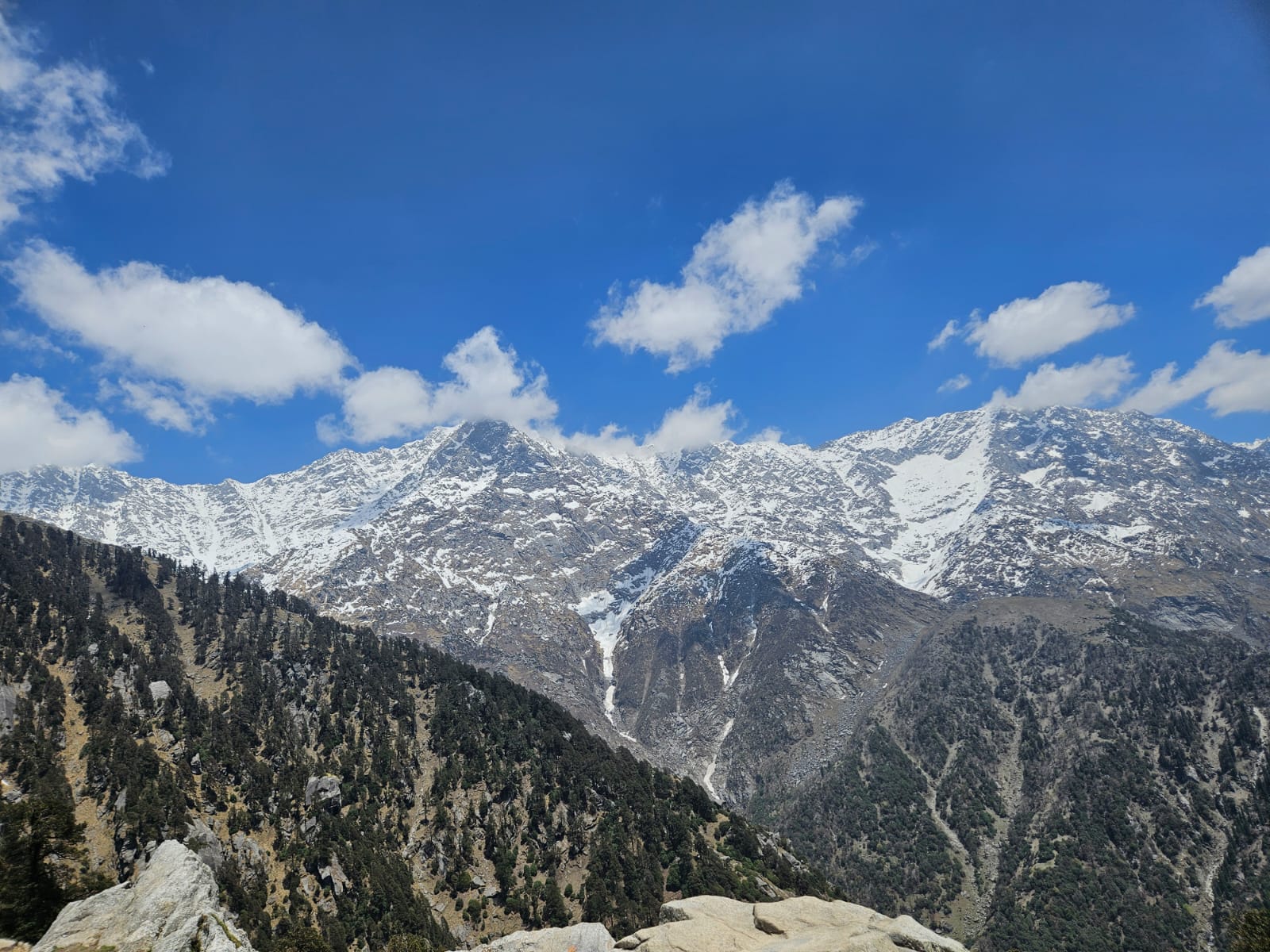
Blue sky, crisp bright sunshine, cool wind in my hair and the snowcapped peaks of Nanda Devi, Panchachuli and Trishul right in front of me.
This is Binsar!

Last summer, when the heat of the plains felt too intolerable, the misty cold air of the Himalayas invited us yet again to the Kumaon side of Uttarakhand to discover quiet corners, lost history and soak in the untouched fresh air. Binsar is a little hamlet close to Almora at a height of 8000ft and houses a Wildlife Sanctuary. It is possibly the best trekking spot for beginners for wonderful day treks with a little bit of a challenge. This post will dwell on the history, treks and some unmissable places from Binsar with a bonus glance into the Bazar’s of Almora.

History:
It is said that the name Binsar comes from Bineshwar Mahadev Mandir, which lies at the heart of the wildlife Sanctuary. In Kumaoni, this word means “New Morning” or “Nav Parbhaat” reflecting the picturesque environment.
Binsar Forest Loop:
Possibly the first thing that comes up when you search for Binsar online is the trekker’s favourite Binsar Forest Loop. Situated deep within the Binsar wildlife sanctuary, this loop takes you to the topmost point of Binsar a.k.a Zero Point, crosses some historical properties and Bineshwar Mahadev Mandir. We started our trek at the base point from Simba café. It is easy to find guides there or you could simply follow the route marked on the “All Trails” trekking app.

The complete loop is of 5kms and is a steep uphill climb. I would recommend carrying trekking sticks for a better grip. The forest path is beautifully laid with leaves and the sun glistens from behind the tall canopy of the trees. Summiting Binsar peak at Zero point(8000ft) feels like an achievement for an amateur trekker!
Mary Budden Estate and The Grand Oak Manor:
Within the loop is Mary Budden Estate, established in 1889, which takes you back to the quiet, forgotten colonial history of Binsar. Sir Henry Ramsay, better known as the “King of Kumaon” was the commissioner of Kumaon & Gharwal region from 1856 to 1884. He was known for implementing infrastructural development for the Kumaon region. His residence, known as the Grand Oak Manor, is now a heritage hotel within the Binsar loop. Likewise, the missionary which was once called Mary Budden estate, is also converted into a heritage property. Both these estates represent a historical testament of a bygone era of Binsar but hidden within the thick forest cover of the Wildlife Sanctuary.

Bineshwar Mahadev Mandir:
Right at the entrance of the loop is Bineshwar Mahadev Mandir, the presiding deity of the town and the source of its name. Even before we started the trek, the stoic presence of the temple invited me. From a distance, it looked very similar to Jageshwar Dham and once you enter the temple it feels like you have traveled back in time!

The poojari(priest) told us that the temple is nearly 1000 years old and houses the deities of Shiva, Parvati and Bhairav Baba in it. The legend goes that King Prithu built this temple for his father in the 9th-10th century. It is also said that the Chand Dynasty established the temple in the 16th century.
With that, the Binsar Wildlife Sanctuary loop came to an end. You can find refreshments in Simba Café. It took us around 3 hrs to comfortably complete the trek. The sanctuary is a home to 200+ species of birds and animals and is a popular spot for bird watching. I would suggest going in the morning as there is a higher chance of spotting some interesting birds. Don’t forget to take your binoculars!

Vimalkot Mata Mandir:
On our short stay in Binsar, we wanted to pack in as many treks as possible! Hence, we set out on the 3km short trek to Vimalkot Mata Mandir. The path to this temple was through a narrow, mud road from Dhaulchina. The sharp trek from the road through the mountain ranges was simply spectacular!

The path was laid with pine cone and it’s leaves. As I kept climbing the hill, I could see the clouds descending and I felt as if I could touch the sky! At that moment, I saw the snowcapped mountain ranges stare back at me.
How could one not stop and admire the majestic Himalayas and wonder at this marvel of nature!
Vimala Mata is known to be the deity of justice, much like Chitai Golu Devta. It is said that on the hill, right opposite the temple, was once the court of justice of the Katyuri Dynasty. Those subjects who felt that they didn’t get justice would turn to Vimala Mata. The goddess is also worshipped for fertility, prosperity and abundance.

While descending the hilly temple, we got to taste some local berries known as kaphal, plums and apricots. They were sweet, slightly tart and fresh. These sort of experiences makes forest bathing deeply meditative and self-exploratory.
Bazars of Almora:
It must be odd seeing Almora in a post for Binsar.
But Almora, being the heartland of Kumaon, needs to be mentioned, yet again!
That evening, we planned to visit Tagore Bhavan in Almora’s cantonment area, which we had missed on our previous trip. Almora is a hilly town where roads are connected through narrow stairways. We were dropped at the beginning of the bazar, by the bus stop and had to embark on a steep trek all through Lala Bazar, Chowk Bazar, Tedhi Bazar and Paltan Bazar to the cantonment area.
The bazars of Almora are a visual treat!

You get to see colorful Kumaoni dupattas, traditional artefacts, baal mithai, singori, utensils, woollens and many more. Although, we rushed through these Bazars as Tagore Bhavan would be closed by 6pm, we saw the locals catching up over chai and samosa, children rejoicing the start of summer under the clear blue sky and fresh Himalayan air. I just wanted to hold time still and witness this slow life of the hills.

We reached Tagore Bhavan by 5.45pm. If you have been following my blog, you would know that I am a big fan of Rabindranath Tagore. When I read Jorasanko and Daughters of Jorasanko by Aruna Chakravarti, I knew that I had to visit this place in Almora!

Debendranath Tagore, Rabindranath’s father, was a very spiritual man and spent most of his later years meditating in Almora. Later in 1903, Rabindranath arrived with his ailing daughter Renuka, with the hope that the clean Himalayan air would heal her. Tagore Bhavan was his residence.

It has Gurudev’s bust, some historical edifice and a mark of this great man. Going to Jorasanko in Kolkata has always been on my bucket list but visiting Tagore Bhavan in Almora gave me a perspective into the life of the pained genius poet who sat by these hills and penned some verses of Gitanjali.

Katarmal Surya Mandir:
One cannot leave Almora or Binsar without paying a visit to Katarmal Surya Mandir(Sun temple). Situated at a distance of 10 km from Binsar on the way to Kausani, the temple was built in the 9th century by a Katyuri King, Katarmal and is popularly known as Baraditya.

Around the main temple, there are clusters of 45 smaller shrines. A short walk from the parking lot gets you to the temple while enjoying the view of Nanda Devi range.

Katarmal Surya Mandir
Binsar is a very quiet, offbeat getaway for those who enjoy nature, treks and history. It isn’t a buzzing spot for adventure activity, nor does it have conventional “tourist spots”. But it invites you to stay, unwind and heal yourself through the stillness that the Himalayas offer.



Leave a Reply