
The Kingdom of Vijayanagara which thrived from 1336-1646 CE was the home of ancient temples and ruins of regal buildings. Stretching over 4 dynasties ( Sangama, Saluva, Tuluva, Aravidu), the citadel of the Kingdom was originally known as Vidyanagara. At the heart of modern-day Hampi, lies the Royal enclosure.
The Octagonal Bath:
 |
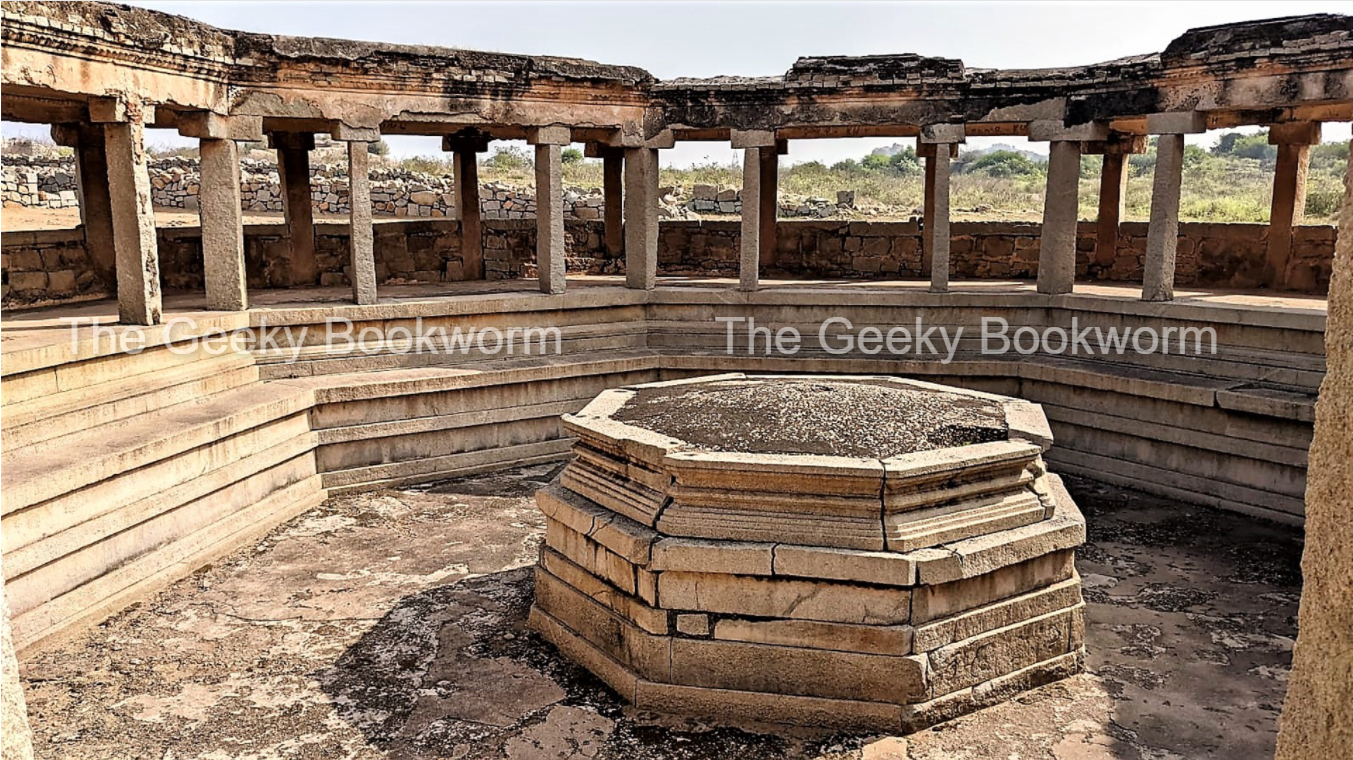
| The octagonal bath (pc: Rajni) |
The octagonal bath which closely resembles a Turkish Hamam was built specifically for the members of the Royal family. It consists of an octagonal mandapa with a pool in the centre. In the middle of the pool, there is an elevated structure made up of marble, to store soap and other toiletries. A ceiling clad with diamonds and precious stones is said to have existed.
The Queen’s Bath:
 |
| Queen’s bath |
The Queens’s bath was a more luxurious private bath built exclusively for the women of the royal family. It is an open bath with a water filtering system right outside. The bath consists of domes on 4 sides and a pool at the centre.
There was also a provision for shower. Music used to be played for the entertainment of the women from the balconies. When I closed my eyes, I could picture the serene music, the rejuvenating bath and the strong fragrance of sandalwood and turmeric.
Mahanavami Dibba:
The Mahanavami Dibba is a royal enclosure uniquely built for celebrating Dusshera. It consists of the King’s pedestal and a vast parading ground. It is said that during Dusshera, the heavy monolithic doors used to be pulled open by the elephants and everyone dressed in their best attire used to gather at the mandapa, to witness the yearly parade. It was burnt to ashes when the Bahamani Sultanate destroyed Hampi. As I entered through the gates, which is now covered with wild growth I could visualize how colourful and grand the festivities would have been!
 |
| Monolithic door |
 |
| Stage of the Mahanavami Dibba |
 |
| The Mahanavami Dibba |
Step Well:
I also stumbled upon an intricately crafted step-well based on geometric patterns. It is said that the stone used to construct this well was procured from Warangal. The well was fed with water from the Kamalapura Lake through the brilliant aqueduct system.

 |
| Aqueduct system |
Underground Secret Meeting Room:
A structure that surprised me the most was the underground meeting room. In the basement of Vishnu temple, this room was used for exchanging highly classified information. Although the ceiling no longer exist, entering and exiting this room through the steep rock-cut stairs is an experience altogether. Imagine being a spy for the King of Vijayanagara in the 16th century, arriving at this secret room stealthy to inform the higher authorities about an incoming danger. Ah, the thrill and excitement!
 |
| Underground secret room |
Lotus Mahal and Elephant Stable:
A little further from the Mahanavami Dibba exists the Zenana enclosure. King Krishna Deva Raya’s wives Queen Tirumala Devi and Queen Chinna Devi had their respective palaces.
 |
| Lotus Mahal |
Unfortunately, all the wooden palaces were burnt down during the invasion and only their foundation exists now. One of the most popular palaces from Hampi is the Lotus Mahal, originally named Chitrangini Mahal. It looks like a lotus from the top, has mesmerizing architecture and a natural air conditioning system. The Elephant stable that housed 11 Royal Elephants and Mahout’s quarters showcases the richness of the Kingdom.
 |
| Elephant’s Stable |
 |
| Mahout’s quarters |
Walking away from the ruins, I could only picture the sheer pain and angst of destruction. The mighty war with the Bahamani Sultanate not only destroyed the kingdom but also the lives of the inhabitants. Their houses were burnt to the ground and their livelihood was disrupted.
 |
| Lotus Mahal |
The ruins of Hampi stand tall with pride
For nothing can erase its presence
Or it’s fertile existence
From the leaves of history, rich and wide!
If Hampi interests you, do read about the Temples of Hampi and about ruins of the Ancient Vanara Kingdom in Kishkindha.


Leave a Reply