
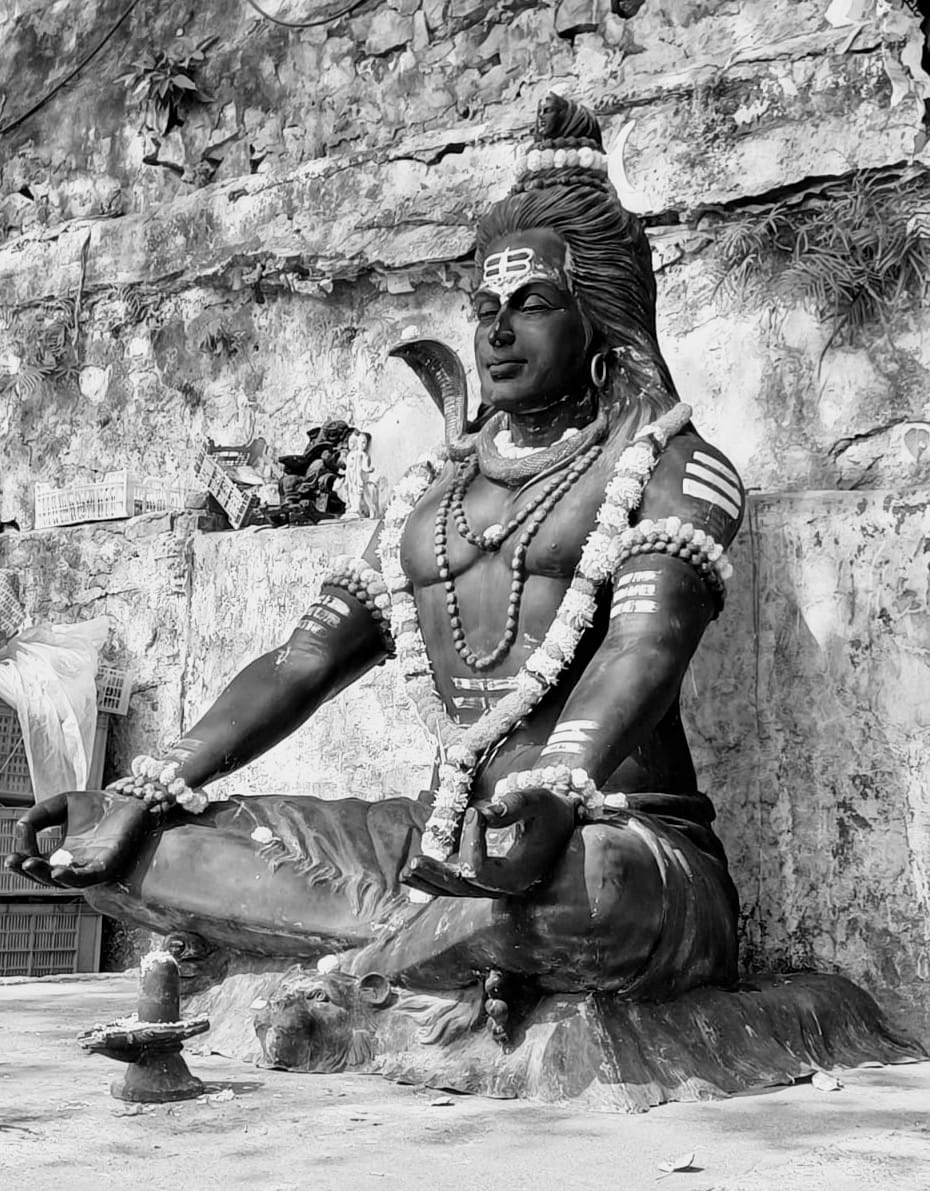
Mahashivratri is a night of great spiritual essence. Many people believe that it was on this occasion that Lord Shiva and Parvati got married. While it is a popular belief, this is only one part of the tale. It is a unique night where one gets to experience the spiritual elixir on the path towards higher consciousness.
While the world celebrates Maha Kumbh in Prayagraj, this blog will entail beautiful and historical temples dedicated to Lord Shiva in Mumbai.

Shivratri and Mahashivratri in the Hindu calendar
The word “Shiva” has many meanings and one of them is “nothingness”. Hence, Shivratri which means the night of Shiva, where one takes refuge in nothingness. The fourteenth day(Chaturdashi) of every month in the lunar calendar(Hindu calendar) is celebrated as Shivratri for practitioners of the spiritual path to continue their Sadhana(disciplined practice) in order to reach liberation(Moksha).

Of the 12 Shivratris, Mahashivratri is celebrated with great pomp and joy in the Hindu month of Magh(Between February and March) . There are multiple tales of faith and beliefs for the importance of this night.

The most popular story is that Mahashivratri is the occasion of the union of Shiva and Parvati. In many temples across India, this occasion is still celebrated as a wedding ceremony with all the festivities surrounding it. Another legend states that Mahashivratri is the night when Samudra Manthan(churning of the Divine ocean) took place and Lord Shiva drank the poison which came out as a result of the churning.

A great tale in Shiva Mahapuranam goes about describing this night of splendour where the trinity of Brahma, Vishnu and Mahesh unite, thereby transmitting a divine force on Earth.

Moreover, it is also the night of the Divine Union of Purusha(Witness – Consciousness) and Prakriti(Matter – Activities related to the mind), symbolising the mergence of the Divine grace and the force of creation.
Spiritual Awakening:
It is often said that one must stay awake throughout the night and perform their poojas(worship) & meditate on Shiva.

Not only does it mean literal Awakening but also metaphorical!
It is the Awakening of the heart from darkness and ignorance towards light and enlightenment.

Ancient Shiva temples in Mumbai:
These are a few historic temples in Mumbai that you can visit on Mahashivratri:
Babulnath:
Situated in the heart of Girgaum Chowpatty, Babulnath is the perfect spot for spiritual tranquility, amidst the hustle and bustle of Mumbai. Legend goes that centuries ago, a cowherd Babul was grazing his cattle in this area. One of his cows Kapila started putting out all her milk in one spot and this puzzled him. On digging that land, he found a Shivling. It was in that very spot the temple Babulnath was built.

The original deities of the temple were consecrated back in the 12th century by Raja Bhimdev of the Solanki dynasty. But over the years the deities were lost and rediscovered in the 19th century and at that time the current structure of the temple was constructed.

Situated on a hillock, Babulnath transports you into another world as soon as you entire the premise. No noise, no chaos just complete stillness right from climbing the hillock to reaching the sanctum sanctorum. It was so still that I sat in the temple, meditating and inculcating the spiritual condition within me.
The walls of the temple have anecdotes from the Shiva Mahapuranam.

Ambernath Mahadev Mandir:
Would one have wondered that a temple constructed back in 1060 AD would be active to this day in Mumbai?

Well, that is the very existence of Ambernath Mahadev Mandir in the suburb of Ambernath, Ulhasnagar. “Amber” in Sanskrit means sky. Ambernath hence means, the Lord of the Sky. This name takes its form in the sanctum sanctorum open to the sky with no ceiling. The temple’s construction began in the hands of Chittaraja of the Silhara dynasty and was completed by his younger brother Mummumi who was a feudatory of the Chalukya kingdom in 1060 AD.

The temple was rediscovered in 1850. The arcitechture is in classical style with rich carvings of Shiva, Parvati, Lakulisha and others.
The calming temple, resembling a cave brings in immense peace as soon as you enter. The ancient pillars with beautiful carvings takes you to the time when Shilpa Shastra(Manuals for sculpture and Hindu iconography) in India was in grandeur. One has to climb down the narrow stairway of 9 steps to reach the Garbhagriha(sanctum sanctorum) which is 8 feet below.

As soon as the eyes drift up to the ceiling which is open to the sky one can’t help but imagine the vast expanse of the consciousness that dwells outside is also within us.
During every Mahashivratri, this temple has a 4 day art and cultural program called the Shiv Mandir Art Festival which celebrates Shiva, the eternal consciousness.

Jogeshwar Mahadev Mandir:
Within the densely populated slum dwellings of Jogeshwari East, lies the 1500 year old Jogeshwari caves. Built by the Chalukyas in the 6th century, the cave has temples dedicated to Jogeshwari Devi(Parvati) and Jogeshwar Mahadev(Shiva). Jog or Yog means Union. Jogeshwar is the one who has mastered yoga.

Having visited the marvellous cave temples of Badami, these caves looked like an early learning practice for the master craftsmen from the Chalukya empire. There are plenty of carvings right from wedding of Shiva and Parvati, Lakulisha, Shiva in meditation and more. Sadly, years of wear and tear and poor maintenance has made most of the carvings unrecognisable.

One first enters the cave and pays allegiance to Jogeshwari mata. Only then can one proceed with exploring the cave and its layout. In the darkness of the cave, the guiding light of the Jogeshwar temple attracted me. In a very tiny dwelling, this temple brings seekers to join in and experience the stillness within.

Apart from these temples, you can also visit Walkeshwar Banganga Tank in Malabar Hill for a heightened experience of tranquillity.

But to truly understand the importance of inner peace and solitude on this day of Mahashivratri, one has to look inward and meditate.
The beauty of Mahashivratri lies within its nature of being the night of spiritual pursuits.
It is a spiritual congregation of various souls to elevate human consciousness and to move one step forward in the journey of spirituality!



Leave a Reply