

Recently, I stumbled onto the works of one of the greatest writers Hindi Sahitya has ever produced, Mannu Bhandari! She was spearheading the Nayi Kahani movement in the world of Hindi Literature which was all about modernity, feminism and inculcating new ideas into our world, lest we become obsolete.
From this era, her works come across as a breath of fresh air, full of perspective on human psychology. Most of her works have been made into movies, for example, Rajnigandha was an adaptation of her short story Yehi Sach Hai.
I picked up Aapka Bunty (in Hindi) by looking at its reviews and didn’t realise that I would be drawn into such an emotional rollercoaster!

Plot:
Written in 1971, Aapka Bunty is too ahead of it’s time. The book starts with Bunty admiring his mother getting dressed up for work. She was the Principal of the girl’s college right opposite his home. It was summer break and Bunty goes about his day, troubling his nanny, playing with his toys, caring for the plants in his garden and painting. On getting bored, he goes to his friend Titu’s house and tries to play with him when Titu mentions that Bunty’s parents are getting divorced. A young child of 8 or 9 who has been living with his mother for as long as he can remember with occasional visits from his father, Bunty doesn’t understand the meaning of divorce(Talaq).
This sets the tone of the novel which unfolds painfully through Bunty’s narration. He sees his house broken, his dream of a two parent household shattered, his childhood home uprooted only to see both of his parents moving on with new partners and family, almost immediately. The feeling of being a burden to parents who see him only as a pawn in their personal power struggle, resonates throughout the novel. Amidst all of this, Bunty is forced to grow up early and become resilient at the adversities pushed onto him by his parents.

Character Sketch:
Bunty/ Arup Batra:
Although the book has been named “Aapka Bunty” as if a child is signing off a letter, towards the end one realizes that the title is a child’s cry for acceptance, love, belonging and identity. Unfortunately, he doesn’t get it and is consumed in the “divorce” crossfire of both his parents.
Bunty’s journey throughout the novel is one that is so tragic that is breaks your heart into pieces every single time, word by word, page by page. In the first half of the novel, Bunty’s innocence and joy is shown in contrast to his mother Shakun’s perpetual melancholy. He reflects hope and somehow wants his parents to live together again by resolving their fight and reconciling as “friends”. In his sheer innocence, he doesn’t realise that his parents had absolutely no interest in talking to each other, let alone reconciliation.

Most of his time in the first half was spent playing with his toys, reading stories and living in an imaginary world with a lot of fictional characters while playing the fool with his nanny (Phuphi). This was his routine during summer break and the child yearns to return to school, to live the normalcy of childhood.
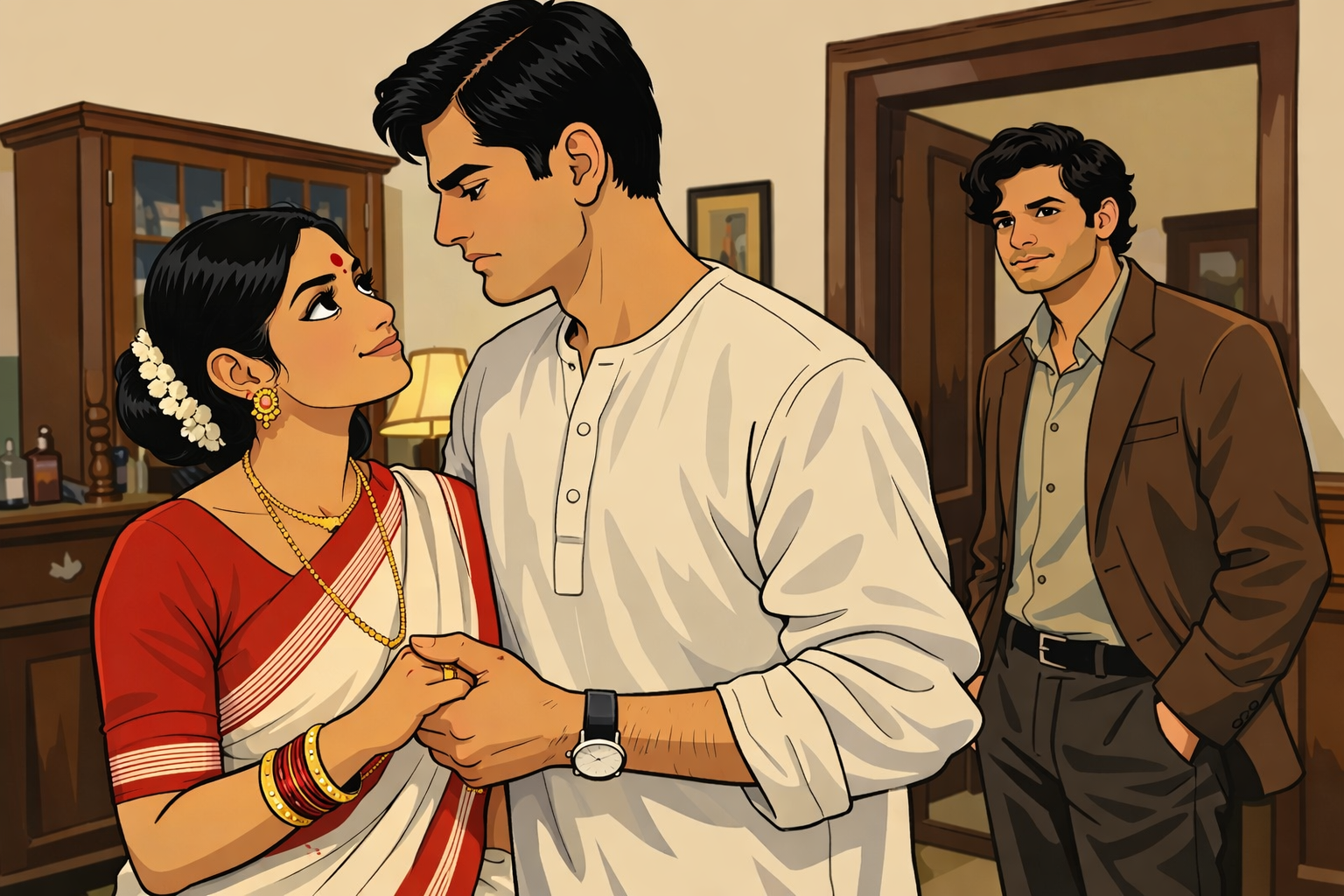
All of a sudden, he sees his mother dating Dr. Joshi. He is introduced to the doctor’s children Jyot and Amit and is told that they are his new siblings. He always knew that his mother wore a mask of a Principal and wasn’t her natural self at work but in front of Dr Joshi, a new version of his mother appears, completely unrecognisable to him. When she is married to the doctor and happily adorns vermilion (Sindhoor) on her head, Bunty is caught in complete disbelief. It was at that time, that he is not only uprooted from his childhood home but is left to experience this tragedy all alone with the departure of Phuphi to Haridwar.
This was probably Bunty’s breaking point. His mother forcing him to call Dr Joshi “Papa” and being treated as a troublesome outsider just adds fuel to the fire. His mind is full of incoherent thoughts, he suppresses his emotions, which start purging as bouts of anger and he starts throwing tantrums just to hear his mother scold him, for the sake of her attention.

All of this leads to Bunty moving to Kolkata with father, in the hope of a better life. But seeing his father, Ajay with his new wife, Meera and their child Chinu, breaks his heart even further. He is no longer able to study or pay attention to his education. When he is finally put into a hostel, one sees the child Bunty forced to grow up very early into a resilient Arup Batra.
The most ironic thing in Bunty’s tale is his love for gardening. When he moves with his mother to the doctor’s house, he doesn’t let his mother uproot his plants from his old garden. It is as if Bunty standing as a fortress, protecting those helpless creatures because no one could protect him when he was uprooted from stability to complete chaos and instability.
Shakun:
Shakun is a 36 year old single mother and the Principal of a girl’s college. Nothing much is mentioned about Shakun’s past like her family history or the initial stages of her marriage with Ajay. As readers, one only knows that Ajay and Shakun’s marriage lasted 2 years and was a power struggle from the day one. They officially separated when Bunty was a baby and Ajay moved to Kolkata. He would occasionally visit his son and buy him gifts. Divorce is finalized seven years later when Ajay wanted to move on and settle down with Meera who was already pregnant by that time.

Although she was initially repulsed by the idea of remarriage, Shakun is infuriated by the information and she too jumps into the bandwagon of moving on, just to one up her ex. There are only two chapters with Shakun’s perspective and in both of them, one can’t help but feel sorry for her predicament. She probably came with the baggage of societal conditioning and although financially empowered, she wasn’t mentally empowered. She too conforms to the societal norms by getting remarried at the cost of Bunty’s stability and starts blaming the child for breaking her new marriage.
Ajay:
Bunty’s father Ajay Batra was a lawyer who lived in Kolkata with his second wife and child. Towards the end of the novel, Bunty moves in with him and understands that the love from his father is strictly transactional. There is only one chapter from Ajay’s point of view. After reading that, one understands that Ajay is a traditional father who believes that his duty ends with providing for his son. Be it buying gifts, taking him out or even funding his expensive boarding school, Ajay doesn’t offer any emotional comfort to his son who was completely torn and breaking from the inside.

Dr Joshi:
Shakun’s second husband Dr Joshi is a widower with 2 children, Jyot and Amit. He provides her with stability and the title of a married woman, one that Shakun yearned for! He doesn’t believe in discussing about his emotions when Shakun asks him how he processed his first wife’s death. He is very much a provider like Ajay, letting the women raise his children(first Chachi Amma and then Shakun) only barging in to either buy gifts for them or to discipline them.
Phuphi:
Bunty’s nanny Phuphi lives with them until Shakun remarries. She is Bunty’s rock and source of support. When she sees an inevitable end to Bunty’s childhood due to both parent prioritizing themselves rather than the child, she leaves for Haridwar. The last string of stability was Phuphi and her departure leaves Bunty completely broken.
Writing Style:
Mannu Bhandari has done a fantastic job with the narration of the novel. The story is mostly in the form of a stream of consciousness from the child Bunty’s point of view. Initially there is a distinction between his thoughts, imagination, dialogues and reality. But towards the end, everything becomes an incoherent amalgamation reflecting Bunty’s state of mind on being betrayed by both his parents.
The level of Hindi too changes – a simplistic almost childlike form when Bunty is the narrator and a complex form when Shakun or Ajay narrate. I hoped for more information on Shakun and Ajay’s life and marriage as this incomplete information makes it an uncomfortable read. But that is precisely what she intended, for us to see life through Bunty’s eyes, just accepting decisions imposed on him and a complete suppression of his voice.

This was a monumental book in Hindi Sahitya and relevant even in today’s times. It is not an easy task to write through the lens of a 8-9 year old boy and make such a great impact in the eyes of the reader. Mannu Bhandari beautifully illustrates a fundamental truth that surrounds us: To err is human.
From Bunty’s point of view, both his parents are wrong. But when one reads Shakun’s narration or Ajay’s, one realises that there was never a right or wrong in the case of divorce. The only thing one can do as an adult is make sure that they soften the blow on concerned children.




Leave a Reply